Monday, 23 December 2013

Pop goes Christmas


There doesn't need to be much of an excuse to crack open the fizz in the TG household, but I know that I won't be alone in popping a cork or two this Christmas. For many, Christmas morning will start with a Bucks Fizz, which is fairly innocuous as Champagne cocktails go, being comprised in half from freshly squeezed orange, but all the same, a step too far far me. Much as I love a tipple, breakfast, (even on Christmas morning), is too early for Mr TG and I who will be sticking to a nice pot of tea until midday, when the bacchanalia begins in earnest. Whilst I've had little to do with the festive preparations this year, having been too busy, painting glass, I have found time to road test a few, new Champagne Cocktails that might just take your fancy this Christmas, although I suggest that unless you want to wake up, face down in a plate of turkey, you join me in holding off until midday…

This first cocktail is a nice alternative to the classic Buck's Fizz and has a gorgeously, festive hue that makes it perfect for a Christmas Day tipple.

Melba Fizz

Ingredients
1 oz Gin (Pinkster would be perfect)
1 oz Catron Creme de Pêche de Vigne
6 fresh raspberries
Champagne or Cava

Muddle (squish) the raspberries in the bottom of your cocktail shaker, along with the Creme de Pêche de Vigne.
Add the gin, a little ice and give it a quick shake just to cool the liquid.
Double strain the cocktail into a chilled glass and then transfer to a chilled champagne flute. This will avoid spilling the cocktail down the side of the glass if your champagne flutes are narrow at the top.
Carefully top up with fizz, avoiding overspill and then briefly stir with a swizzle stick to mix the drink.


This next cocktail is a very delicate shade of green with an equally delicate flavour. The trick is not to overdo the Blue Curaçao, thus lending the drink a hint of orange and a beautiful sea green shade.

Hummingbird

Ingredients
1 oz Gin
1/2 oz Blue Curaçao
1 tsp fresh lime juice
Champagne or Cava
Twist of lime zest to garnish

Add the Gin, Blue Curaçao and lime to a large mixing glass, with ice and stir briefly to mix the liquids.
Strain the mixture into a chilled champagne flute and top with fizz.
Twist the strip of lime zest over the cocktail to release the citrus aroma and garnish the drink.


Now tequila may not be a drink you immediately associate with Christmas or with Champagne for that matter, but dispel those preconceptions and open your mind and your tastebuds to this delicious concoction that combines these two elements in a surprisingly light and pleasant quaff.

Angelic

Ingredients
1 oz tequila resposado
1 oz Chase Elderflower Liqueur
6 grapes (skins removed)
Champagne or Cava to top up
2 slices of grape to garnish

The easiest way to remove the grapes from their skins is to cut them in half and then hold the halved grape between your forefinger and thumb and pinch them together. The grape should just pop out. If not you can remove any little bits of skin by double straining the drink at the end.

Muddle (squish) the grapes with the tequila in the bottom of a shaker.
Add the Chase Elderflower Liqueur, a little ice and shake briefly to chill the liquids.
Double strain the cocktail into a chilled champagne flute and pop in the sliced grape.
Top up with chilled Champagne or Cava.


This final cocktail uses just a taste of Creme de Violette to give a floral note without straying into parma violet territory. The combination of Absolut Raspberri vodka and fresh raspberries keep the flavour fresh and light and a couple of dashes of simple syrup are all this needs to sweeten it.

Raspberri Royale

Ingredients
1 oz Absolut Raspberri
1 tsp Creme de Violette
2 tsp simple syrup
4 raspberries
1 raspberry for garnish

Muddle (squish) the raspberries with the vodka and add everything else except the garnish in the bottom of the shaker.
Add a handful of ice and shake  to cool the liquids.
Double strain the cocktail into a chilled champagne glass and pop a raspberry in the bottom of the flute.
Top up very slowly with Champagne or Cava to avoid the cocktail fizzing over.
Gently stir with a swizzle stick.


I hope that you have a wonderful holiday season and remember; a Champagne cocktail is not just for Christmas….

Wednesday, 18 December 2013

Absinthe makes the heart grow fonder...


Not many drinks can lay claim to their very own faerie manifestation, but the iconic image of 'La Fée Verte', popularised  in the 19th century and reinvented in the form of the preternaturally pert, Kylie Minogue in the film Moulin Rouge, is synonymous with Absinthe. Legend has it that the anise flavoured spirit is imbued with hallucinogenic properties and that given the right circumstances (vast amounts of alcohol and a copy of the aforementioned film), the green fairy will appear. Tosh and poppycock of course, but it doesn't stop people trying...

Absinthe is a curiously mouth numbing concoction that derives it's colour and flavour from the botanicals that it's distilled with; the most notable being 'wormwood' or 'artemisia absinthium', to give it, it's Latin name. Wormwood, apart from sounding like a character from Tolkien, is also credited with giving absinthe it's mind altering capabilities due to the presence of Thujone, a ketone that was erroneously thought to act on the brain in much the same way as THCs in cannabis. However, this turns out not to be the case as in fact, Thujone is most likely to cause muscle spams and convulsions - yikes! But you needn't worry, because the levels of Thujone are so minuscule that you would have long since died from alcohol poisoning before you could possibly consume enough Absinthe for the Thujone to kick in. The most likely explanation for the accounts of it's hallucinogenic properties are down to a combination of things - mainly, it's high alcohol content (it's distilled at anywhere between 45%-75% ABV) and perhaps the copper stills that it was originally made in. Poor maintenance, lax standards and highly unregulated production could have resulted in contaminated Absinthe that may have led to sightings of green fairies and goodness knows what else. Sadly, Absinthe's reputation is largely unfounded, but it is certainly a drink to be reckoned with.

The history of Absinthe dates backs to the 1790's when French Doctor, Pierre Ordinaire absolved himself of his inauspicious monicker and created his 'cure all' tonic by distilling the bitter  leaves of the wormwood plant with other herbs, local to his home in Switzerland, such as anise, lemon balm and hyssop. Rumour had it that he obtained the recipe from a pair of sisters who had been making this tonic for years, but whatever the truth, it remained the medicine of choice for the jolly Swiss locals until it hit the big time in 1797 when the Pernod brothers opened their distillery in Couvet, Switzerland and began production on an international scale. Distilleries opened all over France and the success of the Pernod brothers encouraged less conscientious producers to get themselves a cut of the action, resulting in unadulterated and frankly dangerous 'Absinthe'.

In the 1840's, Absinthe was used by the French army in North Africa, ostensibly as a water purifier (one assumes the bacteria were too inebriated to be bothered causing dysentery) and as a malarial preventative (again, rendering the mosquitos incapable of action...). Upon returning home, the soldiers brought with them a taste for the green stuff and it's popularity spread with such intensity across France, that the time between 5 and 7 in the evening when bourgeoisie hit the cafés for a post work beverage became known as 'l'heure verte' (The Green Hour'. From then on, Absinthe became very much associated with bohemian Paris and it's artists and poets such as Lautrec and Baudelaire which all helped to fuel it's seditious reputation.

Several years of reduced wine production in France due to weather conditions meant that Absinthe began to outsell it's vine grown rival and the country's annual consumption grew to a mind boggling 21 million litres, which made it's subsequent ban all the more shocking... So what went wrong? How did the French fall so badly out of love with Absinthe?

Well, no doubt it was due in part to pressure from the very rich and powerful wine producers who were unable to compete with low price of Absinthe and put added pressure on the government to find fault with the drink. Lurid tales of licentiousness and crime caused by drinking Absinthe, abounded and were much played upon by the press. The presence of Thujone which was considered a dangerous neurotoxin was grossly exaggerated and there was growing popularity for the Temperance movement across the whole of Europe which called for the ban of all types of alcohol. The final nail in the coffin for Absinthe was a terrible murder case in which the main protagonist had murdered his entire family whilst bombed out of his brain on vast amounts of alcohol. Much was made of the Absinthe he had consumed, although it was but a drop in the ocean of all the types of alcohol that had passed his lips before he raised the gun to his family. Nonetheless, a scapegoat was required and the whole debacle was labelled the Absinthe Murder by the gutter press. A nationwide ban ensued and many other countries took up the cause, although not Britain as we were probably too drunk on cheap gin to care.

Around the 1990s the myth and legend of Absinthe began to re-emerge and brave, young hedonists set forth on a quest to get annihilated on Absinthe in the hope of seeing 'La Fée Verte', but sadly, most were only to discover Le Green Sick and Le  Big Headache. Finally in 2002 the ban was lifted and production began in France once more and by 2007, even the US were allowing Absinthe back on their shores.

The traditional way to drink Absinthe is to place a sugar cube atop a slotted spoon, above a glass of Absinthe and drip cold filtered water through the sugar until it reaches the desired sweetness and dilution. There is a pleasing element to the rigmarole of this old fashioned routine, but it is of course, entirely unnecessary; a dash of simple syrup and a little water would produce the same results, but where's the fun in that?

As for Absinthe cocktails, well, the list is extensive; the Savoy Cocktail Book lists 108 cocktails containing Absinthe, the majority of which, use the spirit in minimal amounts. This is because the overriding flavour of anise and aforementioned mouth numbing property tend to destroy all other flavours in it's path. Many other absinthe cocktails from the book sound like the deranged and dangerous concoctions of a hormonal teenager left in possession of their parent's cocktail cabinet, containing nothing but hard liquor with an ice cube chucked in. (Note to any rooky Absinthe pilferers; do not attempt to top up the bottle with water to cover your tracks - also applies to Pernod and Ouzo as I discovered when I was 13) However, there are a few drinks that I would like to share, that you will hopefully enjoy whether or not you are already a fan of Absinthe.

The first is a classic cocktail with a name that has quite a history… The Monkey Gland cocktail was apparently named in reference to the experiments of much ridiculed and frankly, bonkers scientist, Serge Voronoff who, in the 1920's believed he could enhance male libido by grafting the tissue of monkey testicles onto human ones. The cocktail, one presumes, was supposed to do much the same job, although my findings, unfortunately, do not bear this out. Neither Mr TG or myself were overcome with lust after sharing a Monkey Gland, but we did agree that it was a pleasant enough drink with perhaps, just a hint of Benylin Cough Mixture to it.

Monkey Gland

Ingredients
1 1/2 oz Gin
1 1/2 oz freshly squeezed orange juice
1 tsp Grenadine
1 tsp Absinthe
Twist of Orange zest for garnish

Add everything except for the garnish, to a cocktail shaker with ice.
Shake hard, until the outside of the shaker begins to frost.
Strain into a chilled martini glass.
Twist the strip of zest over the drink to release the orange aroma and garnish.


Next up is a variation on a variation of a classic, the Corpse Reviver No. 2. The esteemed cocktail writer, Harry Craddock wrote that the Corpse Reviver should be imbibed 'before 11am or whenever steam and energy are needed'. The original hair of the dog cocktail, the Corpse Reviver No. 1 is a fairly unremarkable drink, but the No.2 is really rather wonderful. It's primarily a gin cocktail, but the smallest dash of absinthe gives it a depth and complexity that would otherwise be lacking. My variation was down to a lack of Lilet Blanc, a fortified wine that tends to be grouped with vermouth, but has a flavour all of it's own. In it's absence, I used a sweet vermouth, which, while different to the original, is still a great drink.

Corpse Reviver No.2 #2

Ingredients
1 oz Gin
1 oz triple sec
1 oz sweet vermouth
1 oz fresh lemon juice
1/4 tsp Absinthe
Twist of lemon zest to garnish

Add the Absinthe to a chilled martini glass and 'rinse' the glass- i.e. swill the Absinthe around to coat the inside of the glass and discard the excess (if any).
Add everything except the garnish to a shaker with ice and shake hard until the outside frosts over.
Strain the cocktail into the Absinthe rinsed glass 
Twist the strip of lemon zest above the drink to release the citrus aroma and garnish.


Moving away from the classics, this next cocktail is one of my own creation. It combines the heat of ginger and smoke of tequila with green tea, lime and a hint of absinthe. The flavour is complex, earthy and warming with the heat of the ginger, blending with the spirits to tame their flavours. 

The naming of this cocktail turned up an interesting little story that seems oddly appropriate. I was searching to see if I could find a colloquial name for a Mexican fairy and whilst that search proved to be fruitless, I came across an amusing news story from 2011 concerning an out of work brick layer from Guadalajara who claimed to have found a real live fairy. And what do you think he did with this momentous discovery? Why, he pickled her in formaldehyde and charged people to come and see. I like to think that our Mexican Fairy would have a happier end…

Mexican Fairy

Ingredients
1 1/2 oz Tequila Resposado
1/4 oz Absinthe 
2 oz chilled green tea
1-2 tsp freshly, finely grated ginger root
1 oz fresh lime juice
1/2 oz simple syrup
Slice of fresh ginger to garnish

Prepare the green tea ahead of time and allow to cool. The best green tea is made from loose leaf, infused for about 5 minutes using water that has cooled slightly from boiling point.

Add the spirits and fresh grated ginger to a shaker and muddle (squish) to really release the fieriness of the ginger.
Add the rest of the ingredients, apart from the garnish, with a handful of ice and shake hard until the outside of the shaker becomes frosty.
Double strain the cocktail into a tumbler filled with ice, to ensure the fibrous ginger is left behind and pop in the slice of fresh ginger.


As the name suggests, this next cocktail has a real kick, provided in the main from the chilli infused Campari, details of which you can find here - Chilli Infused Campari. Add to that, triple sec, a little Absinthe and Champagne and you've got yourself quite the little pick me up!

The Kick

Ingredients
1 oz triple sec
1/2 oz chilli infused Campari
1/2 oz lemon juice
1 tsp Absinthe
Champagne to top up

Add everything apart from the Champagne to a shaker with a little ice and give a quick shake, just to chill the contents.
Strain into Champagne flute and top up with Champagne or Cava


There's no messing around with this final cocktail - it contains a full shot of Absinthe and it's flavour is pure anise. What I like about this is the way it combines with the coffee and syrup to taste like liquorice for grown ups. However, if liquorice isn't your thing or you were planning on using your taste buds for anything else within an hour of drinking it, then it's probably not for you.

Absinthe Espresso Martini

Ingredients
1 oz Absinthe
2 oz chilled espresso coffee
1/2 oz simple syrup

Add everything to a shaker filled with ice and shake hard until the outside becomes frosted and then shake some more.
Strain the cocktail into a chilled martini glass.


Just for the record, the Absinthe used in all these cocktails was Nemesinthe and the Gin was actually Aldi own brand, Oliver Cromwell Gin. I had read in the Guardian that it had received various awards, following blind tastings and felt obliged to try it. I can confirm that it's not bad at all and at around £13 for a litre, it's worth getting a bottle to stock up your cocktail bar.


Friday, 15 November 2013

Vitamin C


Mr TG and I have oft remarked that since I began my foray into the world of mixology, neither one of us is ever likely to fall foul of scurvy, given the vast amounts of limes we habitually consume through the medium of cocktails. Our livers may be the size of an elephant's, but by jingo, our vitamin C levels are through the roof...This week's cocktails all feature cranberry juice which is also high in vitamin C, not to mention antioxidants and flavonoids and has been shown to have an antibacterial effect in the body - admittedly, the health benefits are largely mitigated by the addition of sugar and alcohol, but it does look pretty and it tastes good too.

For those of you of an age to have been partying in the 90's, you will no doubt have sampled the delights of cranberry cocktails. The Cosmopolitan, the Woo Woo and the Seabreeze were all cocktail bar favourites and still persist today, but I wanted to mix up my own drinks, using some of my favourite ingredients. My problem with the aforementioned cocktails is that they all feature vodka, which is fine, but it doesn't bring a lot to the drink other than alcohol content and I wanted to mix some drinks that created new flavours with the cranberry, drawing on that slightly bitter fruitiness.

I personally love a cocktail with bitter sweetness to it and am a big fan of Campari and Aperol, so the combination of cranberry with that, works perfectly and creates the most beautiful colour as well. Cranberry and orange work very well together, so the bitter citrus of Campari and the sweeter orange of triple sec in this first cocktail, are a great combination with the juice. I used Williams Chase GB Gin as it's big, juniper and spice notes are fantastic with Campari and the addition of a little lemon juice balances out the flavours.

Vitamin C

Ingredients
3/4 oz Campari
3/4 oz Triple Sec
1/4 oz freshly squeezed lemon juice
2 oz cranberry juice
Dash of sparkling water
Strip of orange zest to garnish

Add the everything except the sparkling water and garnish to the bottom of a shaker or large glass, with some ice and stir until the outside begins to frost.
Strain into an ice filled tumbler and add a dash of sparkling water to taste.
Cut a strip of zest from the peel of an orange and twist over the drink, releasing the essential oils, and garnish.


This next cocktail was inspired by the Woo Woo, which is a rather sickly mixture of vodka, peach schnapps and cranberry juice. I actually used to love this drink, but since discovering the joys of Catron Creme de Peche de Vigne, I could never return to the artificial flavour of peach schnapps. The original drink is served long, over ice whereas this is served in the Martini Style. Rather than vodka, I have used Bloom Gin as it's delicately floral flavour works beautifully to enhance the peachy notes, rather than overpowering them. To avoid the flavour being too sweet, the addition of lemon juice is a must and as with all Martini Style drinks, it must be as cold as possible, so shake, shake, shake....

Poinsettia

Ingredients
2 oz Bloom Gin
1 oz Catron Creme de Peche de Vigne
1/2 oz freshly squeezed lemon juice
2 oz cranberry juice
Strip of orange zest and fresh cranberries to garnish

Add all of the ingredients to a shaker and shake hard for about 20 secs.
Strain into a chilled martini glass and garnish with a strip of orange zest and fresh cranberries, as shown.


Now I have to be honest and 'fess up that I originally made this last cocktail with Bloom Gin and it was delicious. In my opinion it was even nicer than the rum version, but I absolutely love gin above all other spirits, so I would think that. In the interests of proffering options to those of you who who might want to drink something other than gin, I thought it only fair to try it with rum too and actually, it is very nice. The trick is to use a rum agricole such as the Clément Blanc which has an almost fruity taste to it and to avoid one that might be too nutty in flavour, which doesn't sit well with the Elderflower.

Cranberry and Elderflower Mojito

Ingredients
2 oz Clément Blanc Rum
1 oz freshly squeezed lime
6-8 fresh mint leaves
1 oz Chase Elderflower Liqueur
Dash of simple syrup
2 oz cranberry juice
Sprig of mint and fresh cranberries to garnish

Add everything but the cranberry juice and garnish to a shaker and muddle (gently squish with a blunt ended utensil) the mint with other ingredients.
Add a handful of ice and shake for 20 secs.
Strain into an ice filled glass and top with the cranberry juice.
Garnish with a sprig of mint and fresh cranberries, as shown.


Overall, I found cranberry juice to be a versatile and attractive ingredient despite it bringing back hazy and often toe-curlingly, embarrassing memories of a bygone decade. In fact, I could have made many more cocktails, but Mr TG and I are trying to show some restraint in our cocktail consumption, so my ideas will just have to wait for another post. Watch this space....

Friday, 8 November 2013

Winter Spice


In nature, winter is a time of hibernation, conservation and storing of energy, ready to burst forth and be plentiful again in the spring. Sadly, in the kingdom of men, there is no such respite. We may be top of the food chain, but with great power, comes great responsibility and apparently, it is our responsibility to buy vast amounts of Christmas gifts and eat our way through the rest of the food chain. So no rest for us; while foxes, badgers and squirrels snuggle up until spring, we must pull on our woolly hats and soldier on through the cold, battling the the elements and other high street shoppers as we try to find the perfect Christmas gifts. Alternatively, you could take inspiration from our woodland creatures and snuggle up indoors. Bearing in mind the cost of heating our homes this winter, a soft, woolly blanket, a pair of slipper socks and a cocktail that is guaranteed to warm you up from the inside, sound like the perfect accompaniment to a spot of online Christmas shopping....

After infusing Campari with chilli for last week's cocktail - 'Satan's Circus', I decided ( as I often do ) that it would taste even better made with gin, which proved to be the case in my opinion at least. Now this cocktail may be served chilled, but the heat of the chilli infused Campari will have you feeling toasty in no time. The trick is to infuse the Campari for just long enough to give you a glow without getting into ‘vindaloo’ territory. Let the chilli steep for no more than an hour and the resultant drink will warm you deliciously without burning the throat. To get the recipe for Chilli Infused Campari - click here.

This recipe also requires Cherry Heering, a cherry liqueur made from the maceration of real fruit with an intense, but natural, cherry flavour. If you do not already have some, you can buy online or in store from more specialist purveyors of spirits, such as Amathus Drinks. Finally, you will need gin, of which there are literally hundreds to choose from and all with surprisingly different flavours. I used Gin Xoriguer, a small batch gin from the Balearic island of Menorca, which has enough juniper and spice to stand up to the Chilli Infused Campari.


Cherry Devil

Ingredients
2 oz Gin Xoriguer
3/4 oz Cherry Heering
3/4 oz chilli infused Campari
3/4 oz freshly squeezed lemon juice

Add all of the ingredients to a shaker with ice and shake hard until the outside develops a frosty bloom.
Strain into a chilled martini glass.


This next recipe uses the warming power of ginger to chase away the winter blues and will require making some honey-ginger syrup. To get the recipe for Honey-Ginger Syrup - click here

As the following recipe is a variation of a traditional margarita, it will of course require tequila. It is best to use a ‘resposado’ tequila rather than a young, ‘blanco’ or ‘silver’ tequila as the more aged spirit has an earthier flavour that works best with the honey and ginger.

Ginger Margarita

2 oz Tequila Resposado
1 oz honey-ginger syrup
1 tsp grated orange zest
1 oz freshly squeezed lime juice
Strip of orange zest and slice of ginger to garnish

Add all of the ingredients, apart from the garnish, to a cocktail shaker.
Shake hard for about 20 secs and double strain (to remove the grated zest) into a chilled cocktail glass.
Twist the strip of zest over the glass to release the essential oils and garnish the drink.


Our final winter warmer cocktail is a warm, boozy beverage that can be prepared almost as simply as a cup of tea and in fact, you may wish to scale up the quantities and make a pot for friends.

Rum Toddy

1 1/2 oz dark rum
3/4 oz apricot brandy
1/2 oz lemon juice
1 tsp light muscovado sugar
3 oz boiling water
Cinnamon stick to garnish

Add the rum, brandy and lemon juice to a cup and top up with boiling water.
Add the spoonful of dark muscovado sugar and stir with a cinnamon stick until the sugar dissolves.


Thursday, 7 November 2013

Christmas Spirit - a recipe for success


Picture the scene.....kitchen piled high with crockery, table covered in bits of Christmas dinner, spilled wine, soggy paper hats and cracker toys. Yes, it's Christmas Day, the meal is finished and you think you might just spontaneously combust if you eat another thing. This is traditionally when you would serve a digestif; an alcoholic drink that will aid the digestion  and settle the stomach in order that you can then attempt the Christmas Pud, the mince pies, the cheese and biscuits and the Elizabeth Shaw chocolates which mysteriously materialise during the festive period. Whilst it would make far more sense not to stuff oneself like a goose bound for fois gras, we all know we're going to do it and if a digestif will help (and even if it doesn't), it's worth a try.

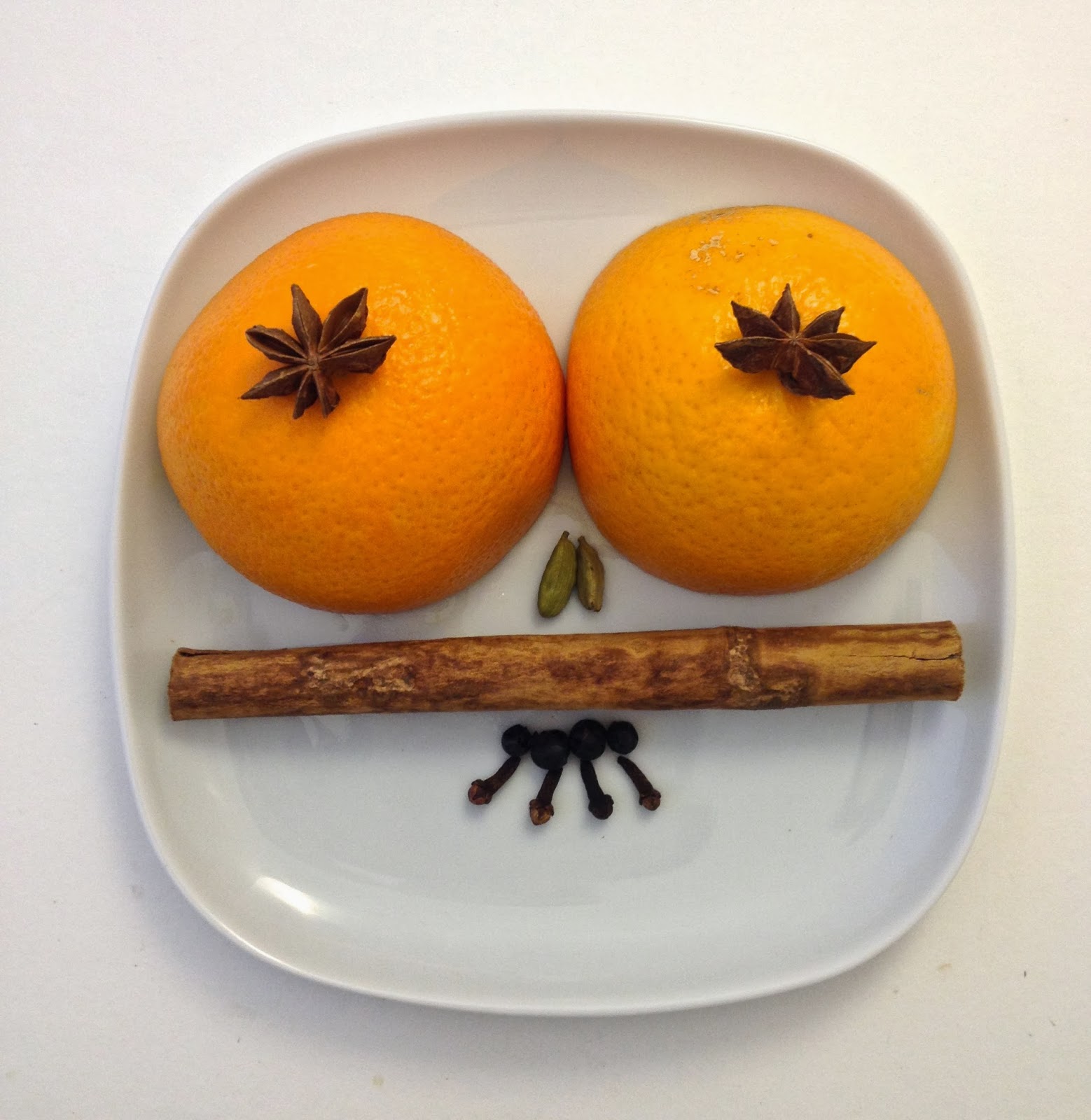
This recipe is for a Christmas Liqueur that you can make at home, really simply and store indefinitely. It improves with age, but can be drunk immediately and is still very pleasant. It uses lots of traditionally festive flavours and creates a drink with a lot of the same flavour notes as a Drambuie, but with vodka, rather than whisky at it's heart. Not only can you serve it up after the Christmas meal, but it will make fabulous gifts for friends and family if you decant it into pretty bottles. 

Christmas Liqueur

Ingredients
600ml vodka
200g light muscovado sugar
Zest of 2 large oranges, peeled off inn strips
1 large cinnamon stick
2 star anise
2 cardamom pods
4 cloves
4 juniper berries
1 vanilla pod
300ml water


When peeling the zest from the oranges, ensure that you do not leave the white pith on. If some remains, scrape it off carefully with your knife.
Add the zest, spices and water to a pan and bring to the boil.
Turn the heat right down and place the lid on tight.
Allow to simmer at the lowest heat for about 45mins - check periodically to make sure the water doesn't boil away.
When the liquid has reduced by 2/3, remove from heat and strain the remaining fluid into a jug, gently pressing the remaining spices etc with the back of a spoon to ensure you extract the maximum amount of flavour.
Discard the solids and pour the liquid back into the pan, bring back to the boil very briefly and add the sugar. 
Stir until dissolved, remove from heat and allow to cool.
When sufficiently cooled, pour on the vodka and stir briskly until fully combined, then bottle and cork it until you're ready to use it.
Ideally, you should wait a week or two to really let the flavours blend, but a sneaky taste won't hurt...


Wednesday, 30 October 2013

Dark Side of the Cocktail Cabinet

Since having children, Hallow'een takes on a very different light, possibly more terrifying than I could ever have imagined. Gone are the quandaries as to which party I should attend and whether or not I should go, 'sexy witch' or 'slutty vampire' and instead, it becomes an evening of cursing every time the door knocker sounds, interrupting my busy sofa surfing schedule with a parade of stunted grotesques, demanding sweets. I am ashamed to admit that despite my children's pleas, I refuse to decorate the doorway or furnish the front step with a pumpkin, lest it should lend further encouragement to  the little blighters to come begging for confectionary. I have noticed that some enlightened recluses actually leave a bucket of sweets outside the door, thus avoiding the awkward shuffling on the doorstep, accompanied by unintelligible mumbling through a (fake) bloodstained, skeleton mask. I am tempted to adopt this approach myself, except that my boys are quite concerned that there would be no sweets left for them....

To mark the spookiness of the occasion (and to ease the pain of social interaction with minors), Mr TG and I will be taking a trip to the dark side of the cocktail cabinet and drinking a couple of bourbon cocktails that look suitably gothic, without veering into parody. Both are drinks I had been meaning to try for some time, having come across them whilst researching material for previous posts and although I do like create my own cocktails a lot of the time, sometimes it is nice to try out what's hot right now.

'Hot' is definitely an appropriate description for our first cocktail, the spookily monikered, 'Satan's Circus', which contains a thai red birdseye chilli infusion that certainly awakens the senses. The original drink was created at the NoMad Hotel in New York and named after the area which was known as 'Satan's Circus' in the 19th Century due to the profusion of brothels and speakeasies that sprang up there. According to Bar Manager, Leo Robitschek, the cocktail was created as a homage to that history and certainly, there is an air of danger to the drink.

I have replicated the recipe as best I can, but the original does call for Aperol rather than Campari, so if you have some, do use that instead. However, I think it's an equally marvellous drink with Campari and Campari does tend to be easier to get hold of. Both Campari and Aperol are Bitters and taste fairly similar, although Campari is higher in alcohol content and not quite so sweet. The most obvious difference to most, however, is in their colour; Aperol is an intense orangey red and Campari, a bright ruby.

The only preparation needed for this cocktail, is to infuse the Campari/Aperol with the thai birdseye chilli, which is simple enough to do.

Chilli Infused Campari

Ingredients
6 oz Campari
1 red thai birdseye chilli

Slice the chilli lengthways and pop it in the Campari with the stalk still on.
Leave to infuse for 1 hour and then remove the chilli.
Strain to remove any seeds and store in a sealed container indefinitely.


Satan's Circus

Ingredients
2 oz rye bourbon (I used Buffalo Chase)
3/4 oz chilli infused Campari
3/4 oz freshly squeezed lemon juice

Add all of the ingredients to a shaker with ice and shake hard until the outside of the shaker frosts over.
Strain into a chilled martini glass.


This next drink also hails from New York and is an unusual, but rather wonderful take on a Whisky Sour. The idea of combining wine and spirits in cocktails is very popular in cool bars, but actually, this drink dates back to the 1870's when there was a trend for creating drinks with a 'claret snap'. Although claret refers to a particular type of wine nowadays, back then, it could be used to mean any type of red wine. The best wine to use for this drink is something rich and fruity like a Shiraz or Malbec and I have used one of my favourites, Yellow Tail Shiraz, which is so fruity and chocolately, it's hard to stop at just one glass. The idea is to float the red wine on the top of the drink so that it sits in two distinct layers, but I recommend that once you have admired your skill at cocktail creation, take a swizzle stick and give it a mix, as it tastes even better that way.

New York Sour

Ingredients
2 oz rye or bourbon whiskey (I used Buffalo Chase)
1 oz freshly squeezed lemon juice
1 oz simple syrup
1/2 oz Shiraz or Malbec red wine

Add the bourbon, lemon and syrup to a shaker with ice and shake hard for 30 secs.
Strain into a tumbler filled with ice and carefully pour the red wine over the back of a spoon so that it floats on the surface in a separate layer. 


If you would like to try something suitably spooky looking this Hallow'een, I can highly recommend you try the 'Ruby in the Weiss' cocktail from my Beer Cocktail post, but to give a special eerie twist, use blue curaçao instead of triple sec. This will taste equally delicious, but the colour will turn from deep ruby to almost black.


Friday, 25 October 2013

Bloom Gin


I've had my eye on the delightfully presented Bloom Gin for quite some time now; ever since it was recommended to me by my favourite purveyors of fine spirits and liqueurs at Amathus City. I was intrigued by it's list of botanicals that include, alongside the essential juniper; sweet honeysuckle, pomelo and chamomile. I was promised a delicate gin that sounded perfect for making the kind of floral and fresh cocktails that I love.

Now don't get me wrong, I love a big, punchy gin as much as the next ginthusiast, but variety really is the spice of life and there's always room in the cocktail cabinet for another juniper based spirit and they really do vary. The only hard and fast rule, to which distillers must adhere when producing gin, is that the predominant flavour should be juniper, but otherwise, the options are infinite. The base spirit is generally a clear, grain spirit (vodka), but even that, needn't be the case, as Chase Distillers have proved, by producing a number of gins using apples from their orchards in Hereford. When it comes to botanicals, gin producers can get creative and no two brands will taste the same. Hendricks, for instance, uses a rose and cucumber infusion, Gin Mare is flavoured with olive and Blackwoods lists water mint and wild violet among it's ingredients, all of which give each gin their own, unique flavour.

Back to Bloom, our light and delicately flavoured gin. As you would expect, it's subtle on the nose; predominantly juniper with floral notes. The flavour is similarly understated and pleasantly sweet on the palate, without losing it's essential gin-iness. The pomelo makes for a softer citrus flavour than usual which is beautifully balanced by the unobtrusive hints of chamomile and sweet honeysuckle. All in all, I think it's rather lovely and would highly recommend it, but do pick and choose your cocktails carefully. The combining elements in some other cocktails could overwhelm such a delicate flower and that would be a shame. You need to make drinks that play up to it's floral delicacy rather than obscure it. There are a number of delicious sounding cocktails on their website that you should definitely have a look at and I have created a few here that I am particularly pleased with. So, without further ado...

I named this cocktail 'Forbidden Fruit' because pink grapefruit, (which is a hybrid of pomelo and sweet orange) when first discovered in Barbados, was given that name. Having a very similar taste profile to pomelo, pink grapefruit is good choice to bring out the best of Bloom gin. It's sweeter than ordinary grapefruit and of course, it's a wonderful colour. I find that basil and pink grapefruit work remarkably well together, but basil is a powerful herb, so less is most definitely more in this case.

Forbidden Fruit

Ingredients
2 oz Bloom Gin
1 large basil leaf
2 oz freshly squeezed pink grapefruit
1 tsp agave syrup
Pink Grapefruit zest and basil to garnish

Before cutting the pink grapefruit to squeeze it, first pare off a long strip of zest, ensuring to leave as much of the pith behind as is possible and set aside for garnishing the cocktail at the end.
Add the gin, basil and pink grapefruit to a cocktail shaker and muddle gently to release the aroma from the basil.
Remove the basil leave and discard before adding the agave syrup and a handful of ice.
Shake hard until the outside of the shaker is completely frosted and then double strain into a chilled martini glass.
Before  garnishing, twist the zest over the drink to release a micro fine spray of citrus oil and gently slap the basil between your palms to allow the aroma of the herb to escape.


This next cocktail makes me think of warm, mediterranean summers. The lemon and rosemary keep it fresh and light and I used Prosecco because it's a touch sweeter. You only need a little of the rosemary syrup, and the peachy citrus notes of the bubbles are perfect with this light and floral gin.

Bubble and Bloom

Ingredients
2 oz Bloom Gin
3/4 oz freshly squeezed lemon
1 tsp rosemary syrup
Prosecco to top up
Lemon zest and rosemary sprig to garnish

Before cutting the lemon to squeeze it, first pare off a long strip of zest, ensuring to leave as much of the pith behind as is possible and set aside for garnishing the cocktail at the end.
Add the gin, lemon and rosemary syrup to a cocktail shaker with a handful of ice and shake.
Strain into a champagne flute and carefully top with Prosecco.
Strip the lower needles from the sprig of rosemary and twist the lemon zest around the stem and garnish.


This last cocktail was my personal favourite, not least because, as soon as I opened my bottle of Bloom Gin, I knew I wanted to make a cocktail that involved chamomile tea and the drink that I created in my head at that moment, worked perfectly. I wanted to use whole dried chamomile flowers to make the tea, but was unable to source them at short notice. However, to my delight, I discovered that teapigs chamomile tea temples are stocked in my local Tesco. Each little 'temple' contains a generous quantity of whole, dried chamomile flowers which brew up to produce a perfect cup of naturally sweet and golden tea. The teapigs website is well worth a visit if you are a fan of tea. It's fun, easy to use and they sell a myriad of loose and bagged, high quality teas.


Chamomile Lawn

Ingredients
2 oz Bloom Gin
1 oz Chase Elderflower Liqueur
1/2 oz freshly squeezed lemon
1 tsp agave syrup
3 oz cold chamomile tea
Sprig of mint to garnish

Pour around 200 ml of just boiled water into a cup containing a teapigs tea temple and allow to infuse for around 10 mins.
Remove the chamomile and allow to cool before refrigerating until chilled.
Add all of the ingredients to a shaker with ice and stir steadily until the outside of the shaker develops a frosty bloom.
Strain the contents into an ice filled tumbler.
Gently slap the sprig of mint between your palms to release the aroma and garnish the drink.